
What Is a Skate Wheel Conveyor and How Does It Work?
Introduction
Did you know that the fundamental idea of using individual spinning rollers to create a skate wheel conveyor dates all the way back to the Industrial Revolution? Workers used simple wooden rollers to do the exact same job. Modern designs have switched to advanced polymers. These are made with precision to ensure high performance while using a concept that is quite old.
Skate wheel conveyors use wheels similar to the ones found under any common movable trolley. Their sole purpose is to reduce friction and ensure smooth movement of goods from one location to another. Its design uses gravity to its advantage. In this article, we will cover everything from the basics of flexible skate wheel conveyor to the technical specifications and safety-related aspects.
What is a Skate Wheel Conveyor?
A skate wheel conveyor is a budget-friendly and highly effective piece of equipment designed to transport lightweight goods. These can be regular boxes, product cases, and plastic bins. It is built using a frame that holds horizontal metal rods called axles. Mounted along these rods are small wheels that spin independently. They allow items to glide smoothly across the surface.
Power-Free Operation: How It Works
Unlike equipment that relies on motors and electricity, these conveyors require no power to operate. Instead, they function as a setup that moves items using a natural downward pull. There are two options to get the product from point A to B on these conveyors:
● Manual Force: Pushing items by hand between the points.
● Declined Slope: Gravity naturally pulls the box along the path using a downward angle.
Flexibility and Historical Origins
These stainless steel skate wheel conveyors have a modular and flexible design. They are a staple in workspaces that need to alter their layouts quickly. You will often see them used in temporary assembly lines or busy, seasonal shipping docks.
Parts and Materials of Skate Wheel Conveyor
Wheels and Outer Structures
Wheels are made from different materials for specific jobs:
● Steel: Coated with zinc, can handle heavy loads.
● Aluminum: Helps provide corrosion resistance.
● ABS Plastic: Ideal for lightweight items to avoid leaving marks.
The frames offer structural integrity even under heavy loads. They use high-gauge powder-coated steel. Alternatively, they use hardened aluminum tracks for durability. Special materials are required for harsh applications, like those using wash-down chemicals. Fiberglass wheels are used here because they are stronger than nylon. Another unique design uses polycarbonate wheels. These can handle high-impact stresses where normal plastic might crack.
Internal Parts and Connections
● Seal: The internal wheel parts have a special protective labyrinth shield. They have oil permanently sealed inside for life. This removes the need for constant repairs and ongoing maintenance.
● Axles: The axles are spaced on 3-inch or 4-inch variable axle centers. You adjust this spacing based on your smallest box.
● Connection: You can connect stainless steel skate wheel conveyor pieces in two ways. Temporary setups use hook and rod couplers. Permanent setups use flat metal joining plates called butt plates.
Shapes, Layouts, and Paths of Skate Wheel Conveyor
Direct Routes and Turns
Straight sections provide the most direct path for goods. They come in standard widths ranging from 12 to 30 inches. In comparison, differential action curves allow boxes to turn corners smoothly. Because the wheels have independent rotation, the outside wheels can spin faster than the inside wheels. This keeps packages on track much better than standard roller conveyors.
Joining Lines and Bending Frames
Connecting tracks or merging spurs allow products to join or leave a main moving line. This is vital for complex sorting and packing setups. You must specifically choose left-hand and right-hand spurs during the early layout planning stage. The merging angle must perfectly match the warehouse's current flow.
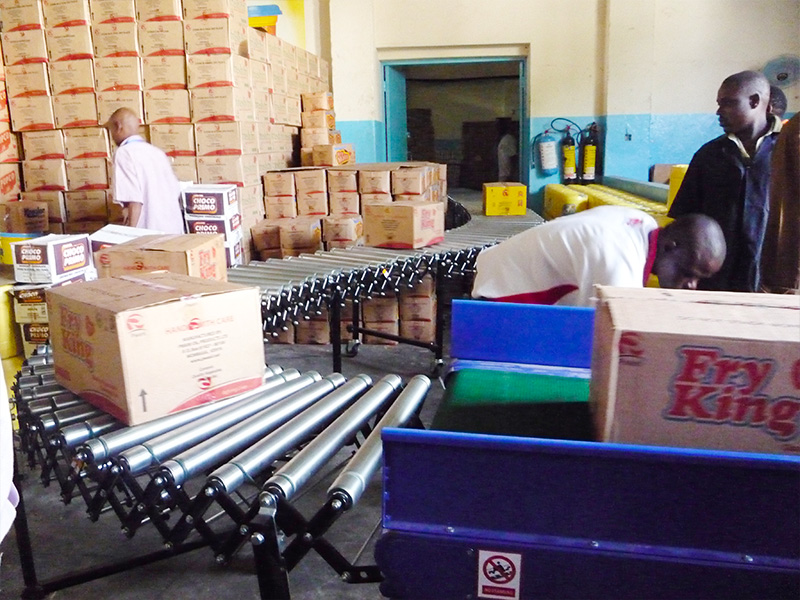
Some models feature a scissor-style frame. These frames can expand, contract, and bend up to 360 degrees. This helps them navigate through narrow aisles. High-end models can stretch out or pull back their length drastically. This helps cover the empty space between loading docks and the inside of shipping containers.
How Does a Skate Wheel Conveyor Work?
Moving with Gravity and Managing Turns
Because only a few wheels touch the box at once, there is very little static friction to movement. This means a light push or a slight downward angle gets things rolling. When the skate wheel conveyor is set up on a downward angle, the weight of the box easily pushes past the wheels' low resistance, moving it forward on gravity propulsion.
The weight of the items is well distributed across a large number of contact points. It reduces the point-pressure on both the floor and the bottom of the product. When going around corners, the individual wheels spin at differential speeds. This acts much like a car's axles, ensuring product orientation without needing side walls/guides in most cases. You can even use crossed or banked skate wheel patterns to automatically push items back to the middle. All of these features eventually ensure that the box has the right orientation.
Finding the Right Angle (Pitch and Slope)
These systems need a smaller pitch to move boxes compared to standard rolling conveyors. This creates high efficiency for the required pitch. Because they do not need a steep vertical drop, warehouses with low roofs or limited floor space can use these gravity flow systems where larger conveyors would not fit. This saves valuable vertical clearance.
You can easily adjust the decline using telescopic leg sets. This lets operators adjust the height at both ends to find the exact travel speed for specific package weights. A tiny downward slope of just 1% is usually enough to get things moving. However, it is always recommended to test this with a product mix.
Key Benefits and Industrial Applications
Why They Beat Standard Roller Belts
These conveyors offer excellent mobility. Because they are lightweight and often sit on heavy-duty casters, a single operator can easily move them. They are also highly budget-friendly because they rely on simple design and have no motorized components.
When it comes to moving small item handling, these systems shine. Because the wheels provide more contact points, they can safely transport items that are too small and would otherwise fall through the open spaces on a conventional conveyor. Because there are fewer moving parts and absolutely no motors or chains, they require very little upkeep. This drastically cuts down on both repair bills and downtime.
They also offer ergonomic benefits. The smooth, easy movement lowers the physical strain on the body, which reduces workplace injuries caused by heavy lifting or dragging. In fact, research indicates that replacing manual dragging with these conveyors can cut worker fatigue by up to 50% in high-volume sorting areas.
Where They Are Used
● Fast Online Order Sorting
● Routing Mixed Mail Packages
● Moving Heavy Car Frames
● Gentle Medicine Box Handling
● Hygienic Food Crate Transport
● Loading Delivery Truck Trailers
● Secondary Express Picking Lanes
● Heavy Engineering Part Routing
● Bagging System Conveyor Links
● Glass Machinery Component Flow
● Construction Scaffolding Part Staging
● Temporary Factory Assembly Lines
● Retail Backroom Stock Unloading
● Manual Luggage Sorting Zones
Technical Specifications and Selection Criteria
Handling Weight and Support (Load Capacity)
Weight Limits per Wheel and Track
When figuring out load capacity, we look at standard ratings. A single, heavy-duty skate wheel can support between 45 lbs if it is made of aluminum and 65 lbs if it is made of steel. Instead of just looking at individual wheels, the overall system is usually measured by how much weight it can carry per foot of length. Many high-strength models can safely handle up to 200 lbs per linear foot.
The sudden force of a box dropping onto the track is often 25% higher than the box's static weight. Because of this extra stress, the outer frames must be over-engineered to stop them from bending or collapsing.
Component
Standard Steel
High-Grade ABS
Aluminum
Max Load per Wheel
65 lbs
30-40 kg/m
45 lbs
Common Application
Heavy Manufacturing
E-commerce / Retail
Lightweight / Portable
Durability
Highest
High Impact
Moderate / Corrosion Resistant
Stands and Structural Strength
The amount of weight the system can hold is directly linked to the distance between the floor stands. For example, placing the stands 5 feet apart gives you a much higher load rating than spacing them 10 feet apart.
For leg stability, you have two main choices.
● Permanent H-Supports: To keep the system firmly in one place with fixed stability
● Portable Tripod Support: For setups that need to have temporary mobility.
Sizing Your Boxes: The "Rule of Ten"
Minimum Wheel and Rod Requirements
For stable movement, there is a Golden Rule: Every single box must have at least ten wheels underneath it at all times.
There is a strict rule for the axle requirement. A minimum of three axles must be under the box at any given moment. This stops the box from getting stuck on the edges or tipping downward into the gaps between the rows.
Wheel Spacing and Box Types
You must also consider the number of wheels packed into every Wheels Per Foot (WPF). You need a higher WPF rating for smaller boxes. This ensures they do not snag or stumble in the empty spaces between wheels. Because of this specific design, the technology is strictly for items with firm, flat, and smooth bottoms. If you try to move squishy items like polybags, they will sag into the gaps and jam the wheels.
Safety, Maintenance, and Troubleshooting
Here are some key tips to ensure safety during operations and fix common issues with the machine.
● Watch the interface between a powered line and a gravity line. The joint creates a "Wringer" effect that pulls fingers or clothes into the gap.
● Rotating axles can easily catch loose hair, creating entanglement hazards. Keep all guards secured tightly while the conveyor moves during operation.
● Dusty environments need a daily cleaning routine.
● Hose down or blow out daily to ensure that the skates spin freely.
● Investigate failed-to-flow (stall) boxes to fix jams.
● Check for insufficient decline angle and adjust them as required.
● Inspect for damaged bearings or warped wheel tubes.
● Fix tracking issues using diagonal measurements.
● Perform a squareness check on the outer structure/frame.
● An out-of-alignment by even 1/4 inch causes constant package skewing.
● Fix early stops by increasing the wheel density.
● More contact points stop box sag without a steeper pitch.
Conclusion
A flexible skate wheel conveyor stands out as the most versatile and cost-effective answer for today's material handling requirements. It provides incredible ease when navigating flexibility in curves and can be moved around effortlessly by workers for portability.
Whether you are setting up a permanent assembly line or just need a short-term setup for truck-loading, you need a strong partner. Businesses such as YiFan Conveyor offer top-tier, highly efficient setups that are customized to fit your exact warehouse and transport needs.
FAQs
What is the maximum load capacity for a skate wheel conveyor?
Forty-five pounds can be supported by a wheel made of sturdy steel. Wheels made of aluminum can support forty-five pounds. Models with a high capacity may support up to two hundred pounds per linear foot during operation. In case of dynamic load created by dropped boxes, the support need will increase.
What are the packaging requirements for items on this system?
It is required that you only move objects that have flat and firm bottoms. Bags that are too soft will sag and cause the wheels to become jammed. Use the rule of ten in every situation. It is necessary for every box to have ten wheels and three axles underneath it in order to guarantee secure and reliable transportation.
How do you troubleshoot packages drifting sideways during operation?
Sideways drifting means you have a tracking issue. You must check the frame alignment immediately. Take diagonal measurements across the structure to verify exact squareness. An outer frame crooked by just one quarter inch will cause constant package skewing problems.
Related Articles:

Get in touch with us
QUICK LINKS
PRODUCTS
CONTACT US
E-Mail : sales01@yfconveyor.com
24 Hour Hotline : +86 13958241004
Add: No.77,Heyi Road,Gulou Street,Haihu,Ningbo China